
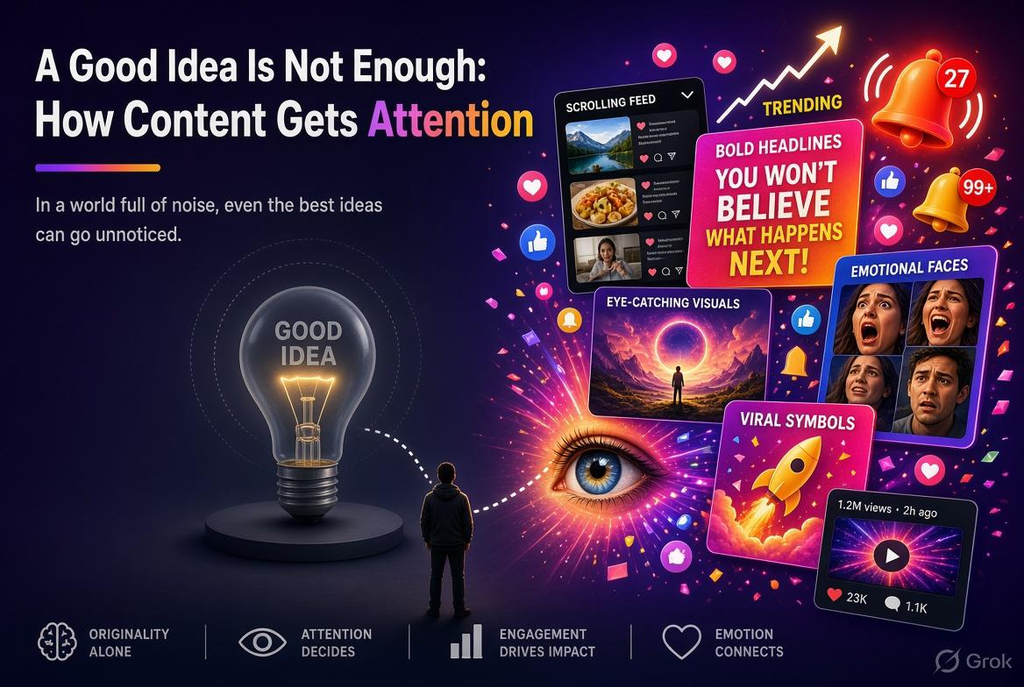
In the digital world, having a good idea is only the beginning. Every day, businesses, creators, entrepreneurs, and marketers publish thousands of pieces of content across websites, social media platforms, search engines, and video platforms. However, only a small percentage of that content receives meaningful attention. Therefore, the real challenge is not simply creating a good idea but presenting that idea in a way that makes people stop, notice, understand, and respond.
A strong idea can fail when the content does not reach the right audience or communicate its value quickly. Conversely, a simple idea can achieve remarkable results when a creator understands the audience, uses effective storytelling, chooses the right format, and distributes the content strategically. This is why successful content marketing requires much more than creativity. It requires planning, execution, consistency, and a clear understanding of how people consume information online.
1. The Idea Is Only the Starting Point
Every successful piece of content begins with an idea. However, an idea alone does not guarantee attention. A business may have an excellent product, an interesting story, or a valuable solution, but customers will not automatically discover it. The creator must transform the idea into content that communicates its value clearly.
Therefore, content creators should think beyond the question, “Is this a good idea?” They should also ask, “Why would someone care about this?” and “What would make someone stop scrolling?” These questions help transform an ordinary concept into an effective piece of creative content that has a clear purpose and audience.
2. Attention Comes Before Engagement
Before someone likes, comments, shares, or purchases, that person must first notice the content. Consequently, attention represents the first major stage of audience engagement. Without attention, even the most valuable message may remain invisible.
Modern audiences encounter an enormous amount of information every day. As a result, creators have only a limited opportunity to communicate why their content deserves attention. A strong headline, visual, opening statement, question, or unexpected idea can create that initial interest. Once the content earns attention, the creator can then guide the audience toward the deeper message.
3. The First Few Seconds Matter
On social media, people often decide within seconds whether they want to continue watching or move to the next piece of content. Therefore, the opening of a video, post, or article needs to create immediate relevance.
A strong opening does not necessarily require exaggeration. Instead, it should communicate a clear reason to continue. For example, a video can begin with a problem, an important question, a surprising observation, or a useful promise. Similarly, an article can use a compelling headline that clearly communicates what the reader will gain. Thus, effective content creation starts by respecting the audience’s limited attention.
4. Know Who You Are Speaking To
Content becomes more powerful when it speaks directly to a specific audience. A creator cannot effectively communicate with everyone using the same message. Different audiences have different interests, problems, expectations, and communication preferences.
Therefore, an effective content strategy begins with audience research. Businesses should understand who their customers are, what problems they experience, what questions they ask, and what type of content they consume. Once creators understand these factors, they can develop content that feels relevant rather than generic.
5. Solve a Problem Instead of Just Sharing Information
People rarely engage deeply with content simply because someone wants to publish it. Instead, they respond when content provides something useful. It may solve a problem, answer a question, explain a complicated topic, entertain the audience, or help someone make a decision.
For this reason, creators should connect their ideas to real audience needs. Rather than simply saying what a product does, a business can explain how the product solves a specific problem. Similarly, instead of discussing a topic generally, an educator can provide practical steps. Consequently, useful content has a stronger opportunity to generate audience engagement.
6. Storytelling Turns Information Into Experience
Facts provide information, but stories can make information memorable. Storytelling gives audiences a structure that allows them to understand why something matters. A story can introduce a problem, show a challenge, present a solution, and demonstrate the result.
Furthermore, storytelling can create an emotional connection between an audience and a brand. A business can share its journey, customer experiences, challenges, achievements, or reasons for starting. As a result, the audience can understand the human side of the business rather than seeing only a product or service.
7. Creativity Makes Familiar Ideas Feel New
Not every successful piece of content introduces a completely new idea. Sometimes, creators succeed by presenting a familiar idea from a different perspective. Therefore, creativity does not always mean inventing something nobody has seen before.
For example, a common marketing concept can become more interesting when a creator explains it through a short story, comparison, demonstration, or real-world example. Likewise, a business can transform an ordinary product feature into an engaging visual experience. Thus, creative presentation can give familiar information a new identity.
8. The Right Format Can Change the Result
An excellent idea can perform differently depending on how a creator presents it. Some ideas work well as short videos, while others require detailed articles, carousels, infographics, podcasts, or email newsletters. Therefore, creators should select formats according to both the message and the audience.
Social media marketing provides many opportunities to experiment with different formats. A complex concept may work better as a carousel, while a visual demonstration may perform better as a short video. Meanwhile, a detailed explanation may require a blog article. Choosing the right format allows the creator to communicate the message more effectively.
9. Strong Visuals Help Content Stand Out
People process visual information quickly. Consequently, design plays an important role in attracting attention online. Images, typography, colors, layouts, thumbnails, animations, and video composition can influence whether people stop and explore content.
However, attractive design should support the message rather than replace it. A beautiful graphic with a confusing message will not create long-term value. Therefore, creators should combine visual appeal with clarity. Strong visual communication should immediately help the audience understand what the content is about and why it matters.
10. Headlines Give People a Reason to Continue
A headline often represents the first written element an audience sees. Whether it appears on a blog, social media post, YouTube video, or advertisement, the headline can determine whether someone continues reading or watching.
Effective headlines communicate relevance without misleading the audience. They can highlight a problem, promise useful information, create curiosity, or introduce a valuable insight. For example, instead of using a generic headline such as “Content Marketing Tips,” a creator could focus on a specific challenge faced by the audience. Consequently, strong headlines can improve online visibility and encourage deeper engagement.
11. Distribution Is Part of Content Creation
Creating excellent content does not automatically guarantee that people will see it. Distribution plays an equally important role. Therefore, creators should decide where and how they will publish their content before producing it.
A business might distribute one idea through Instagram, YouTube, Google search, LinkedIn, email marketing, and its own website. However, each platform requires a different approach. The creator should adapt the format and communication style while maintaining the same core message. In this way, one strong idea can become multiple pieces of useful content.
12. Consistency Builds Recognition
A single successful post can generate attention, but consistency helps build a recognizable presence. When a creator regularly publishes valuable content, the audience begins to understand what to expect from that creator or brand.
Moreover, consistency allows businesses to develop stronger brand awareness. Customers repeatedly encounter the same visual identity, communication style, topics, and values. Over time, this repeated exposure can make the brand easier to recognize. Therefore, creators should focus not only on individual posts but also on building a long-term content system.
13. Data Shows What Actually Works
Creativity provides ideas, but data helps creators understand performance. Metrics such as views, watch time, clicks, engagement, shares, saves, website visits, and conversions can reveal how audiences respond to content.
However, creators should avoid focusing only on vanity metrics. A post may receive many views but generate very few meaningful interactions or business results. Conversely, a smaller piece of content may attract a highly relevant audience and produce valuable leads. Therefore, creators should connect content performance with clear objectives rather than judging success through numbers alone.
14. Content Should Create a Reason to Act
Attention becomes valuable when it leads somewhere meaningful. After attracting an audience, content should provide a clear next step. Depending on the objective, that step could involve reading another article, following a page, visiting a website, contacting a business, subscribing to a newsletter, or purchasing a product.
A clear call to action can guide the audience without creating unnecessary pressure. For example, educational content can invite readers to explore a related topic, while business content can encourage customers to learn more about a service. Therefore, every piece of content should have a purpose within the broader content strategy.
15. From Good Ideas to Content That Gets Attention
Ultimately, successful content requires more than having a good idea. Creators must understand their audience, communicate value quickly, use effective storytelling, choose suitable formats, create strong visuals, distribute content strategically, and measure the results.
A good idea becomes powerful when someone knows how to present it effectively. Therefore, creators should stop thinking about content as simply something they publish. Instead, they should treat content as a communication system designed to attract attention, provide value, build trust, and encourage meaningful action.
Conclusion: Great Ideas Need Great Execution
A good idea can remain invisible if nobody notices it. In contrast, thoughtful execution can transform a simple idea into content that attracts attention and creates meaningful results. This principle applies to businesses, personal brands, entrepreneurs, creators, and marketers alike.
The future of digital marketing will continue to reward brands that understand how audiences think, search, watch, read, and interact online. Therefore, the goal should not simply be to create more content. The goal should be to create better content with a clear purpose.
When creators combine content marketing, content strategy, creative content, storytelling, social media marketing, audience engagement, and consistent distribution, they give their ideas a genuine opportunity to reach the people who matter. In the end, attention does not come from the idea alone. It comes from how effectively that idea earns attention, delivers value, and remains memorable.